The latest Industry News
A pallet can be packed correctly, collected on time and move through the carrier's network without any apparent problem. It can still be stopped during customs clearance because a product description is too vague, an EORI number does not match the business involved, or the packing list shows a different number of packages from the Commercial Invoice.
Customs paperwork is not reviewed as a collection of unrelated forms. Customs authorities, carriers and customs representatives use the documents together to establish what is being shipped, who is responsible for it, what it is worth, where it originated and whether it can legally enter the destination country.
A document may therefore look complete on its own and still create a delay because it conflicts with another part of the shipment record.
Many of these problems can be avoided. A careful check before collection can prevent days of correspondence, additional charges and, in more serious cases, the pallet being refused or returned.
This guide explains which customs documents and shipment details commonly stop pallet freight, what each one needs to show and how to keep the complete document set consistent.
At a glance
Common customs-document problems include:
- an incomplete or inaccurate Commercial Invoice
- a packing list that does not match the physical freight
- a missing, invalid or mismatched EORI number
- vague goods descriptions
- incorrect commodity or HS codes
- unclear Incoterms or a missing named place
- an unsupported country-of-origin claim
- an unrealistic or inconsistent customs value
- incorrect exporter, importer or consignee details
- a missing licence, permit or product certificate
- undeclared dangerous goods
- solid wood packaging that does not meet ISPM 15 requirements where they apply
- documents that contradict one another
The central principle is consistency. The booking, Commercial Invoice, packing list, customs instructions, transport records and physical pallet should all describe the same shipment.
Quick answer: Customs may stop a pallet shipment when the Commercial Invoice, packing list, customs declaration or business details are incomplete or inconsistent. Typical causes include vague descriptions, incorrect commodity codes, invalid EORI details, unsupported values or origin claims, unclear Incoterms and missing licences. A customs query does not automatically mean rejection, but clearance may remain on hold until corrected documents or supporting evidence have been reviewed.
Why customs documents are checked as a complete set
A customs declaration is built from information supplied by the exporter, importer and other parties involved in the shipment.
A carrier or customs representative may prepare and submit the declaration, but the information still needs to be accurate and supported by the underlying commercial and transport records.
Depending on the route and goods, information may be compared across the freight booking, Commercial Invoice or proforma invoice, packing list, customs declaration, road, air or sea transport document, exporter and importer registrations, EORI and tax details, proof of origin, licences and certificates, product specifications, labels or markings on the goods, purchase orders and payment records, and earlier import or export declarations.
A discrepancy does not necessarily mean that anyone has acted dishonestly. It may be a straightforward administrative mistake. Customs or the representative may still need to resolve it before the goods can move.
Examples include:
- the Commercial Invoice states 12 cartons while the packing list shows 14
- the booking shows one pallet while the documentation shows two
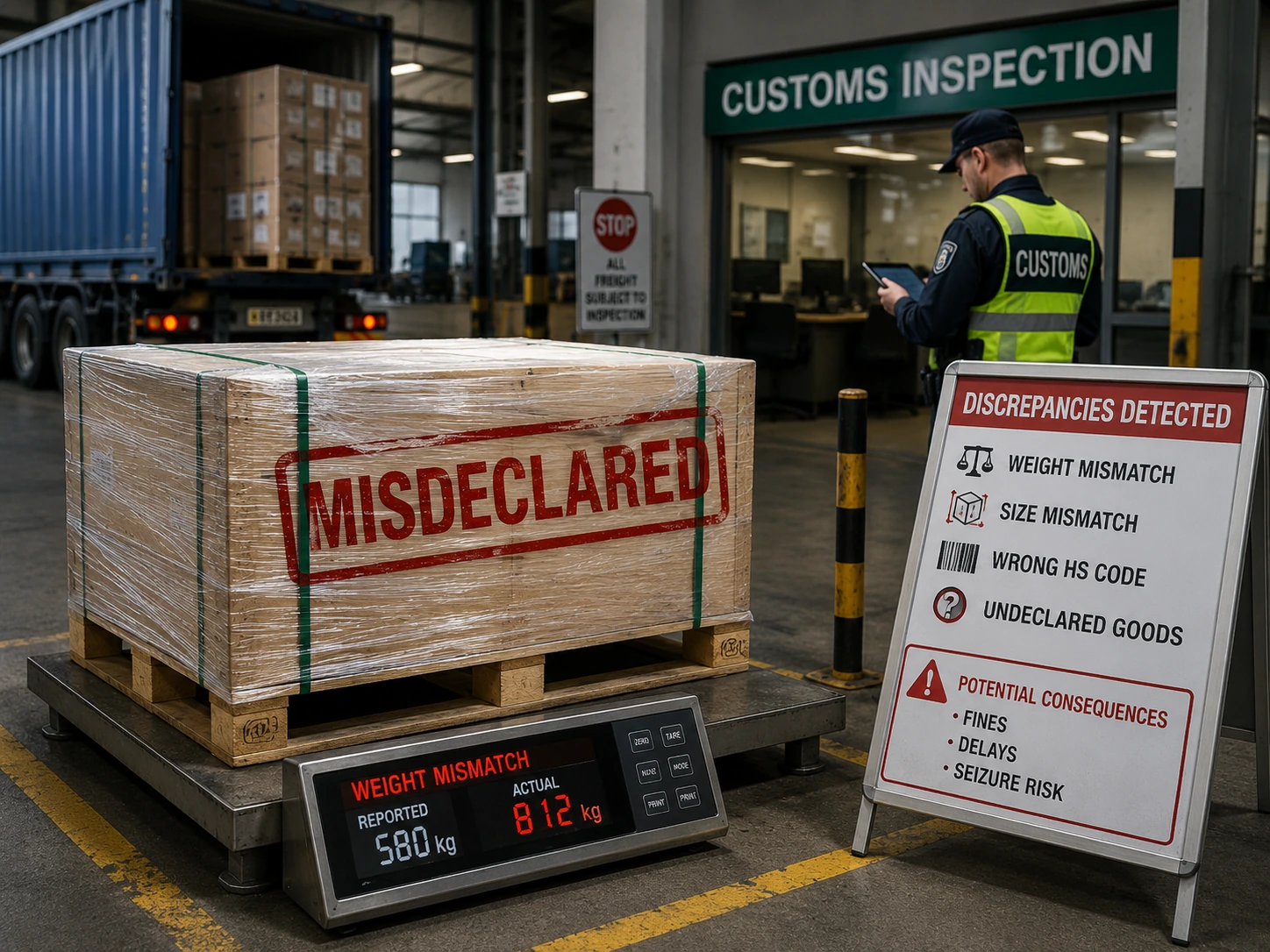
- the measured weight is significantly higher than the declared weight
- the invoice identifies one business as buyer while another is named as importer
- the commodity code does not fit the written description
- DDP is shown but no workable destination import arrangement exists
- the invoice states UK origin while the supporting origin document states another country
Until the uncertainty is resolved, the shipment may remain on hold.
The Commercial Invoice
The Commercial Invoice is the main customs document for goods being sold internationally.
It helps customs identify, classify and value the goods and establish which duties, taxes, restrictions or controls may apply. It is not simply a copy of an ordinary UK VAT invoice or basic sales receipt. It needs enough information for the destination authority and customs representative to understand the transaction.
Depending on the route and goods, a Commercial Invoice will commonly include:
- invoice number and date
- seller or exporter's full legal name, address and contact details
- buyer or importer's full legal name, address and contact details
- consignee or delivery address, if different
- a clear description of each product
- quantity and unit of measure
- unit value and total value
- currency
- commodity or HS code
- country of origin
- reason for export
- gross and net weights where relevant
- freight, insurance and other charges where relevant
- agreed Incoterm, named place and edition
- EORI, VAT or tax identifiers where required
- any route-specific declaration, signature or reference
The exact requirements vary by country, product and shipment arrangement. The principle is consistent: someone unfamiliar with the shipment should be able to understand what the goods are, who the parties are, what the goods are worth and why they are moving.
Business names, addresses and registration details should be consistent across the invoice and customs records. A trading name, abbreviated address or group-company registration may create problems if it does not align with the legal entity involved in the declaration.
Commercial Invoice errors that cause delays
Vague goods descriptions
Descriptions such as "parts", "equipment", "accessories", "samples" or "general goods" may be too vague to identify or classify a product.
A useful description should normally explain what the product is, what it is made from, what it is used for where relevant, the quantity and any important technical characteristic.
For example:
- Weak: Machine parts — Better: Twenty stainless-steel replacement drive shafts for industrial food-processing machinery
- Weak: Samples — Better: Six non-functional plastic packaging prototypes supplied free of charge for customer evaluation; customs value £120
Internal product references can be included, but they should appear alongside a plain-English description. A code such as "PX-442-B" means little to customs on its own.
Values that do not reconcile
Each product line should show an appropriate value and currency. The totals should reconcile with the transaction and supporting records.
Common problems include no currency shown, line totals that do not add up, values that differ from the purchase order or payment record, one total for the entire shipment with no product-level breakdown, a different value on the customs declaration, freight or insurance treated inconsistently, and an unsupported nominal value.
Zero or nominal values
Free samples, warranty replacements, gifts, intercompany transfers and returned goods may not involve a normal sale, but that does not mean they have no customs value.
Where there is no price paid or payable, the standard transaction-value method may not be available. Another recognised valuation method may therefore need to be used.
Entering "£0", "no commercial value" or an unexplained figure such as £1 can lead customs to request evidence of the goods' realistic value.
Some shippers add the words "value for customs purposes only" where goods are not being sold. That wording can explain the circumstances, but it does not remove the need for a supportable customs value.
Incorrect party details
The buyer, importer, consignee and delivery recipient may be different parties.
Using the customer's delivery warehouse as the importer's legal address, naming a group company that has no role in the transaction or entering a trading name that does not align with the relevant customs registration can prevent the declaration from being completed correctly.
Missing Incoterm or named place
Writing only "DAP" or "FCA" may not describe the agreement fully. The named place should also be included, for example: DAP Lyon, France — Incoterms® 2020.
The named place matters because it identifies where particular delivery responsibilities, costs and risks change.
When is a proforma invoice used?
A proforma invoice may be used where the goods are not being sold, depending on the carrier and destination requirements. Examples can include free samples, gifts, warranty replacements, temporary exports, intercompany transfers and items sent for repair, testing or evaluation. (For personal effects, note that Pallet2Ship handles personal belongings through DHL services, which have their own documentation process.)
Although it is not a sales invoice, it still needs to provide customs with enough information to assess the goods. It should normally include sender and receiver details, clear product descriptions, quantities, realistic values, currency, commodity codes where required, country of origin, reason for export and shipment terms or Incoterms where relevant.
"No commercial value" does not mean "no customs value". Where there is no sale, customs may require another recognised valuation basis. Supporting evidence might include a price list, the value of identical or similar goods, manufacturing cost, a previous sale, an appropriate market value, an independent valuation or a calculation under the applicable customs-valuation method.
The reason for export should also be stated clearly, such as "free sample for customer evaluation" or "warranty replacement supplied free of charge".
The packing list
The packing list explains how the freight is physically organised.
The Commercial Invoice focuses mainly on the transaction, classification and value. The packing list helps the carrier, customs representative or inspecting officer identify what is inside each pallet, carton or package.
A separate packing list is not required for every movement, but it is particularly useful for multi-product, multi-package and multi-pallet shipments.
It commonly includes the number of pallets, the number and type of packages, the contents of each pallet or carton, gross and net weights, package or pallet dimensions, packaging type, marks and carton references, and invoice, order and consignment references.
Packing-list errors that cause problems
Problems commonly arise where:
- the booking shows one pallet but the list shows two
- the invoice lists 24 items but the packing list shows 20
- weights were copied from an earlier shipment
- dimensions were recorded before final packing
- mixed goods are not broken down by package
- an invoiced product does not appear on the packing list, or the list includes goods absent from the invoice
- the document refers to an old purchase order
- the package count does not match the freight handed to the carrier
The packing list should be checked against the finished pallet, not against the original warehouse plan. Incorrect weights or dimensions can create both a customs query and a carrier re-rating.
Transport documents and booking records
The carrier booking and transport record should also match the commercial paperwork.
Depending on the mode of transport, the document may be a road consignment note, air waybill, bill of lading or another carrier record.
Details that should be consistent include the sender and receiver, collection and delivery addresses, pallet and package count, gross weight, general goods description, transport references and dangerous-goods information where relevant.
A transport document does not replace the Commercial Invoice, but a contradiction between the two may lead to a query or the movement being paused.
EORI numbers
An EORI is an Economic Operators Registration and Identification number used to identify businesses and certain other operators in customs systems.
The number required depends on the customs territory and the role being performed. For example, a business dealing with customs in Great Britain may require a GB EORI; movements involving Northern Ireland may require an XI EORI or, in relevant circumstances, an EU EORI; and a business importing into an EU member state may require an EORI valid for the relevant EU customs activity or another compliant import arrangement.
EORI problems that stop clearance
Common problems include:
- no EORI supplied
- an incorrect digit
- an invalid or inactive number
- a number belonging to another legal entity
- company details that do not align with the registration
- a GB EORI supplied where an XI or EU EORI is required
- an overseas recipient that has not completed the required registration
- a recipient that has not agreed to act as importer
- the assumption that the carrier will supply a replacement EORI
A GB EORI can be checked through the official GOV.UK service. XI and EU EORI numbers can be checked through the relevant EU verification service.
Customs systems and clearance agents may compare the legal name and address linked to the EORI with the documents supplied. A mismatch can delay clearance until the role and registration have been confirmed.
A valid number does not by itself prove that a business is the correct importer or exporter. The legal entity, declared role, registration and transaction must align.
A carrier or representative cannot simply substitute its own EORI whenever a customer has failed to obtain the registration it requires. The arrangement depends on the destination rules and the form of customs representation being used.
Importer, exporter, buyer and consignee details
International shipments can involve several parties whose roles overlap but are not identical:
- Seller — the business selling the goods
- Buyer — the business purchasing them
- Consignor — the party tendering the goods for transport
- Consignee — the party to whom the goods are consigned
- Exporter — the party treated as exporter under the relevant customs rules
- Importer — the party responsible under the destination-country import arrangement
- Delivery recipient — the person or site physically receiving the pallet
One business may perform several roles, but this should not be assumed.
Common errors include using a trading name instead of the relevant legal entity, using an EORI belonging to another group company, entering an incomplete address, omitting usable telephone or email details, showing a delivery warehouse as the importer, naming an importer that has not agreed to act or lacks the required registrations, using different spellings of the business name across documents, and naming one buyer on the invoice and another in the customs instructions.
Before collection, establish who will be responsible for import clearance and confirm that the business has agreed and is able to perform that role.
Commodity or HS codes
Commodity codes classify goods for customs purposes. The code can affect Customs Duty, import-tax treatment, licences and restrictions, quotas, anti-dumping and other trade measures, rules of origin, statistical reporting and the documents required with the declaration.
Classification depends on more than the everyday product name. It can require analysis of the product's material, function, composition, construction, manufacturing stage and presentation.
Commodity-code errors that cause delays
Common errors include:
- choosing a code from a general product name
- copying a code from an old invoice
- accepting a supplier's code without checking it
- using an outdated code
- selecting the code carrying the lowest duty rate
- using one code for materially different products
- failing to consider material, composition or principal function
- using a code that contradicts the written description
The international Harmonised System provides a common foundation, but individual customs territories can add further digits and national tariff measures. In UK customs declarations, the first eight digits form the core commodity code used for imports and exports. Import declarations may also require digits 9 and 10, along with additional codes, depending on the goods and tariff measures that apply. The full classification required can therefore differ between export and import declarations and between destination markets.
Where classification is uncertain, it should be checked before dispatch. Businesses importing into or exporting from Great Britain can apply for an Advance Tariff Ruling. For relevant Northern Ireland or EU movements, a Binding Tariff Information decision may apply.
A customs representative can help prepare and submit a declaration, but the business must provide accurate technical information. The precise legal responsibility depends on the parties' roles and whether the representation is direct or indirect.
Incoterms
Incoterms® are standard trade rules published by the International Chamber of Commerce. They allocate certain tasks, costs and risks between seller and buyer, including who arranges the main transport, who handles export or import formalities under the chosen rule, where delivery takes place, when risk transfers and who bears specified transport-related costs.
They do not replace the sales contract, transport contract or customs declaration. They also do not determine ownership of the goods.
Incoterm errors that create delays
Problems include:
- no Incoterm, or no named place
- an unsuitable or outdated rule
- one rule on the invoice and another assumed in the booking
- disagreement over who will clear the goods
- a receiver expecting duties to be prepaid when they are not
- DDP being selected without a workable destination import arrangement
- no clear party able to provide importer details
- freight or insurance costs treated inconsistently for customs valuation
For example, a seller may write "DDP" because it intends to pay the destination charges. Under DDP, however, the seller is responsible for import formalities. If it cannot legally or practically fulfil that role in the destination country, clearance may stop while a compliant arrangement is identified.
Incoterms allocate commercial responsibilities, but they do not override the destination country's customs, tax or registration rules. Always state the agreed rule, named place and edition.
Country of origin and proof of origin
Country of origin is not necessarily the country from which the pallet was dispatched. It concerns where the goods are considered to have been produced or manufactured under the applicable origin rules.
Origin is not automatically where the goods were purchased, the seller's country, the exporter's warehouse location, the country from which the freight departed, or the country associated with the brand.
Origin can affect normal duty rates, preferential tariff claims, quotas, sanctions, trade-remedy measures, product controls and supporting-document requirements.
Origin errors that stop shipments
Common problems include:
- UK origin claimed solely because the goods left the UK
- imported goods treated as UK origin without sufficient processing
- preferential and non-preferential origin being confused
- a preference claim made without evidence
- different origins shown on the invoice and certificate
- a supplier statement copied without checking it
- no analysis where goods contain components from several countries
- proof of origin that is missing, incomplete or incorrectly worded
To claim a preferential tariff under a trade agreement, the goods must meet the relevant product-specific rules and the appropriate proof must be available. A product does not become UK origin merely because it was stored, repacked or resold in the UK.
Goods values and customs valuation
The amount shown on a sales invoice is often central to customs valuation, but customs value is not always identical to the headline sale price or insured value.
For goods imported into the UK, HMRC's valuation framework contains six methods. Transaction value is considered first where its conditions can be met.
Depending on the applicable method, relevant factors can include the price paid or payable, freight and insurance, packing, certain commissions, goods or services supplied by the buyer, royalties or licence fees, later proceeds payable to the seller and whether a normal sale exists.
Valuation problems that trigger queries
Common problems include:
- samples declared at zero, or an unexplained nominal value
- relevant transport or insurance costs omitted
- inconsistent currencies
- a value that differs from payment evidence
- deliberate undervaluation
- no explanation for warranty replacements
- an unsupported intercompany transfer value
- second-hand equipment valued unrealistically
- "no commercial value" stated without a customs value
Customs may request purchase orders, proof of payment, sales contracts, price lists, accounting records, previous sales, evidence of identical or similar goods, manufacturing costs or an explanation of the valuation method. The correct treatment depends on the transaction, route and destination rules.
Licences, permits and controlled-goods documents
Some goods require more than an invoice and packing list. Depending on the product, origin, destination, end user and intended use, documents may include export or import licences, proof or certificates of origin, health or sanitary certificates, phytosanitary certificates, veterinary certificates, conformity documents, dangerous-goods transport documents, CITES permits, dual-use or strategic export licences, food or plant documents, excise documents, cultural-goods permits and waste-shipment documents.
UK exporters must check whether goods, software or technology are subject to export controls. Controlled status can depend on the technical specification, destination, end user and intended use.
Documentation failures that stop shipments
Problems include:
- assuming a licence can be obtained after dispatch
- using an expired licence, or one issued to another business
- exceeding an authorised quantity or value
- omitting a required licence reference
- supplying a certificate linked to another invoice
- providing a copy where the destination requires an original or validated electronic document
- using the wrong document format
- failing to obtain destination-country approval
- using product descriptions that conflict with the permit
Compliance with UK export rules does not automatically satisfy the destination country's import and product requirements.
Dangerous-goods documents
Dangerous goods are subject to rules covering classification, packaging, marking, labelling, documentation and handling.
Depending on the goods and mode of transport, information may include the proper shipping name, UN number, hazard class, packing group, quantity, packaging details, a dangerous-goods transport document, carrier approval and supporting technical information such as a Safety Data Sheet.
A Safety Data Sheet can help identify a chemical product and its transport classification, but it does not by itself prove that the goods have been packed correctly or that a particular service will accept them.
Road, air and sea movements follow different regulatory frameworks. Dangerous goods must therefore be declared before the service is selected and booked.
Wooden pallets and ISPM 15
Relevant solid wood pallets, crates and dunnage moving between Great Britain and the EU must meet ISPM 15 requirements. ISPM 15 also applies to imports into Great Britain from most other countries and is required on many other international routes. For exports, the destination country's specific requirements should always be checked.
Compliant wood packaging must be appropriately treated and carry a clear, legible ISPM 15 mark.
Problems can arise where there is no recognised mark, the mark is incomplete or illegible, untreated wood has been used in a repair, the packaging shows pests, bark or contamination, or the destination applies additional plant-health controls.
The ISPM 15 mark is normally the evidence of treatment. A separate paper treatment certificate is not routinely required simply to prove that correctly marked wood packaging complies. Processed wood products such as plywood and fibreboard are generally exempt.
The pallet itself can therefore stop a shipment even when the goods and Commercial Invoice are correct.
Product-specific documents businesses often overlook
Requirements depend on the product and destination. The following examples are not exhaustive.
Food, animal and agricultural products. Possible requirements include health or sanitary certificates, ingredient and manufacturing information, batch details, origin evidence, importer registrations, prior notifications, veterinary documentation and temperature records where relevant.
Plants, seeds and timber. Possible requirements include phytosanitary certificates, botanical names, country of harvest, treatment evidence, permits, protected-species documents and pest declarations.
Chemicals. Businesses may need a current Safety Data Sheet, chemical name and composition, concentration, CAS number, UN number and dangerous-goods classification, packing group, and regulatory or end-use information.
Batteries and electrical goods. Possible requirements include battery chemistry, watt-hour rating, UN number, test evidence, a transport declaration, packaging and marking information, product-conformity records and destination registrations. "Electrical equipment" may be insufficient where the equipment contains a lithium battery.
Machinery and technical components. Customs may request technical specifications, material composition, model or serial numbers, intended use, confirmation of whether the goods are new or used, end-user information, export-control classification and confirmation of whether the goods are complete machines or parts.
Textiles and clothing. Classification may depend on fibre composition, whether the fabric is knitted or woven, garment type, intended wearer, manufacturing origin, and construction and weight. "Clothing" is generally too broad.
Cosmetics and medical products. Possible documents include ingredients, product registration, responsible-person details, conformity documentation, certificates of analysis, labels, import authorisations and evidence supporting medical claims.
Artwork, antiques and protected species. Customs or licensing authorities may require age and date of creation, artist or maker, materials, value and provenance, photographs, cultural-goods permits and CITES permits where protected species or materials are involved.
What happens when documents contradict one another?
| Conflict | Why it matters | Possible response | Prevention |
|---|---|---|---|
| Invoice weight differs from the packing list | It is unclear which document describes the actual freight | Correction request or physical check | Weigh the completed pallet and update both documents |
| Booking says one pallet; packing list says two | Carrier and customs records describe different consignments | Collection query, re-rating or customs hold | Reconcile the booking after final packing |
| Commodity code does not fit the description | The goods may be misclassified | Specification request or classification review | Use a precise description and verify the code |
| Invoice and origin evidence show different countries | Duty preference or controls may be unsupported | Origin evidence requested; preference may be refused | Check supplier declarations and origin documents |
| Buyer differs from importer | The responsible import party is unclear | Importer clarification or new authorisation | Identify buyer, consignee and importer separately |
| DDP is stated but no import arrangement exists | The seller may be unable to complete import formalities | Clearance paused while a compliant arrangement is found | Confirm destination requirements before booking |
| Declared value differs from proof of payment | Customs may suspect an error or undervaluation | Valuation query or reassessment | Reconcile the invoice, order, payment and adjustments |
| Description conflicts with dangerous-goods documents | The carrier may have accepted the wrong type of cargo | Safety hold, rebooking or refusal | Declare dangerous goods before collection |
| Package numbers differ | The complete shipment cannot be accounted for | Inspection or document amendment | Count and label every package after packing |
| Invoice reference differs from the declaration | Supporting records may not be linked correctly | Corrected documents requested | Use one consistent shipment reference |
What happens when customs request more information?
A customs query does not automatically mean the pallet has been rejected. A typical process is:
- A missing, inconsistent or unusual detail is identified.
- Clearance is paused or the freight is placed on hold.
- The exporter, importer, booking party or customs contact is approached.
- Corrected documents or evidence are requested.
- The information is submitted for review.
- The goods are released, reassessed, inspected, returned or escalated.
Requested evidence may include an amended Commercial Invoice, proof of payment, a purchase order or sales contract, product specifications, photographs or catalogue pages, a composition breakdown, an end-use statement, proof of origin, an import or export licence, a Safety Data Sheet, importer registration, an explanation of the customs value or clarification of the commercial parties.
A telephone explanation may not be enough. Customs may require a revised document, signed statement or formal evidence.
When one detail changes, check the full set. Correcting the importer, value or description may require corresponding changes to the invoice, packing list and customs declaration.
Who is responsible for responding?
The correct party depends on the question. It may be the exporter, importer, booking party, customs representative, carrier, supplier, manufacturer or end user. For example, the exporter may need to correct the invoice, the importer may need to provide its registration, the manufacturer may need to provide specifications, the supplier may need to support an origin claim, the customs representative may need to amend the declaration, and the carrier may need to transmit revised information.
Pallet2Ship and the selected carrier can communicate requirements and request information. They cannot invent product details, create an unsupported value, certify an origin claim without evidence or guarantee that a nominated importer is legally able to act.
Customs responsibility and liability depend on the parties' roles and the form of representation used. Direct and indirect representation can have different consequences for the trader and representative.
Businesses should nominate a customs contact who monitors emails and calls, understands the shipment, can access invoices and packing records, can contact the buyer and supplier, can obtain technical documents and can approve corrections promptly. That person should remain available until the pallet has cleared.
Why responding quickly matters
A customs hold may be resolvable, but the freight remains stationary while information is outstanding.
Possible costs include customs-representative administration, warehouse handling, storage, inspection charges, failed delivery or re-delivery, duty or tax reassessment, return transport, disposal costs, and demurrage or detention where applicable to a port, container or terminal movement.
Charges do not arise in every case, and their structure varies by carrier and facility. Where freight remains in a depot, terminal or bonded location, however, costs may continue to accumulate while instructions or documents are awaited.
When can a pallet be returned?
Return may be considered where the importer refuses to cooperate, duty or tax is not paid, no valid importer can be identified, a required licence cannot be supplied, the goods cannot be lawfully imported, the documentation remains unresolved, the goods fail a regulatory inspection, no instructions are received, or a storage or clearance deadline expires.
A return does not necessarily travel under the original booking. It may require a new transport booking, export or re-export procedures in the destination country, a new UK import declaration, evidence of the original export, revised invoices and customs documents, payment of storage and handling, and a claim for Returned Goods Relief where the conditions are met.
Goods rejected at another country's border may be returned to the UK, but import formalities still apply. Returned Goods Relief may reduce UK Customs Duty and import VAT where all eligibility conditions are satisfied, including the requirements concerning the original export and the condition of the returned goods.
Return is not always possible. Some goods require approval before further movement or cannot be lawfully or safely returned.
How to reduce the risk before collection
Before releasing an international pallet:
- confirm the legal exporter and the party responsible for import clearance
- verify the relevant EORI and tax registrations
- agree the Incoterm and named place
- use clear product descriptions
- confirm commodity codes and check the country of origin
- support any preferential-origin claim
- provide an appropriate customs value
- reconcile the Commercial Invoice and packing list
- confirm the final pallet and package count
- weigh and measure the completed freight
- check whether licences or certificates are required
- check destination-country import rules
- identify dangerous or restricted goods
- confirm that the recipient understands its customs responsibilities
- appoint a responsive customs contact
- retain invoices, orders, payment evidence and product records
- provide documents before collection where requested
- use consistent names, addresses, quantities, values and references throughout
Final customs-document checklist
Invoice
- Are the correct exporter, seller, buyer and importer identified, with complete addresses and contact details?
- Is the invoice number and date shown?
- Are the goods described clearly, with correct quantities and units?
- Does each product have an appropriate value, with the currency stated?
- Is the country of origin correct, and the commodity code checked?
- Is the Incoterm shown with a named place, and the reason for export clear?
- Are freight and insurance treated appropriately?
Packing and transport details
- Does the pallet count match the booking, and the package count match the physical freight?
- Are dimensions based on the finished shipment, and was the pallet weighed after packing?
- Are mixed goods broken down clearly?
- Does every invoiced product appear on the packing list?
- Do the transport and invoice references agree?
Customs identities
- Are the appropriate EORI details valid, and the importer correctly identified?
- Has the importer agreed to act, and are required destination registrations in place?
- Do business names align across the documents?
- Is a customs contact available?
Classification, origin and value
- Does each code fit the written description?
- Is the customs value supported, and have free-of-charge goods been valued appropriately?
- Has the treatment of freight and insurance been checked?
- Is the correct origin declared, with proof available where preference is claimed?
Supporting documents
- Are export or import licences required, and are certificates valid and linked to the correct goods?
- Are dangerous-goods documents complete, with technical information available where relevant?
- Are product-specific approvals in place?
- Is relevant solid wood packaging ISPM 15 compliant?
Final consistency check
Do the booking, Commercial Invoice, packing list, transport records and supporting documents show consistent business names, addresses, pallet and package counts, quantities, weights, values, currencies, commodity codes, countries of origin, Incoterms, and invoice and order references?
What Pallet2Ship can and cannot do
Pallet2Ship can guide customers through the booking process, explain the information commonly required and help communicate requests received from carriers or customs representatives.
We rely on the information supplied by the customer and cannot independently verify the contents, classification, value, origin or regulatory status of a packed pallet.
Customers remain responsible for providing complete and accurate shipment information. The precise legal responsibility for a customs declaration depends on the parties involved, the destination rules and the form of customs representation used.
No carrier or freight provider can guarantee customs clearance where the information or supporting documents are incomplete, inaccurate or inconsistent.
Clear paperwork keeps pallet freight moving
International pallet shipments are more likely to be delayed when customs cannot clearly establish what the goods are, who is sending and importing them, how they should be classified, what they are worth, where they originated and whether they are lawfully permitted to move.
Accurate customs documents are not simply an administrative requirement. They provide the evidence needed to prepare the declaration and clear the shipment.
The best time to resolve a customs-document problem is before the pallet is collected. Confirm the parties, product details, values, origin, Incoterms and supporting documents while the goods are still at your premises, rather than after they reach a border or overseas depot.
When arranging an international pallet delivery through Pallet2Ship, check the documentation and destination requirements that apply to the particular goods before booking or collection. You can obtain an instant pallet delivery quote online or contact our UK-based team where a shipment requires additional checks.
---
This guide is for general information only and does not constitute customs, tax or legal advice. Requirements vary by product, route, destination and shipment arrangement and may change over time. Businesses remain responsible for ensuring their shipments comply with the applicable requirements.
If you have any questions regarding our services,
tracking your parcel or advice, we're here