The latest Industry News
A pallet can be collected without difficulty and still run into problems later in its journey. It may be reweighed at a depot, measured by a dimensional scanner or stopped during customs clearance because the information supplied at booking does not match the freight being transported.
Sometimes the difference is straightforward: the completed pallet is taller or heavier than expected. In other cases, the issue is more serious, such as an inaccurate customs value, an incorrect commodity code or goods containing undeclared batteries or chemicals.
Freight misdeclaration does not always involve an attempt to deceive a carrier or customs authority. It often starts with an estimate, copied product data or a booking made before the warehouse has finished packing. However, even an honest mistake can result in additional charges, delays or a shipment being returned.
This guide explains what misdeclared pallet freight means, how it happens, how discrepancies are detected and what businesses can do to avoid preventable problems.
At a glance
Misdeclared freight is any shipment where the declared details do not match the goods being transported — whether that is weight, dimensions, contents, value, commodity code, origin or dangerous-goods status.
Possible consequences, broadly from less to more serious, include:
- re-rating and additional carrier charges
- failed collections or network delays
- customs queries and clearance delays
- duty and tax adjustments
- civil penalties
- return, refusal, or in serious cases seizure or destruction
Many cases of misdeclaration are accidental and preventable. One of the most effective habits is simple: measure, weigh and describe the pallet only after packing is complete, and make sure the booking, invoice and customs documents all tell the same story.
Quick answer: Misdeclared pallet freight means the declared details do not match the actual shipment. Minor discrepancies in weight or dimensions may lead to re-rating and extra charges. Inaccurate customs information — value, commodity code, origin or undeclared dangerous goods — can lead to clearance delays, duty adjustments, civil penalties and, in serious cases, seizure. Accurate information at booking greatly reduces the risk.
What is misdeclared pallet freight?
Misdeclared pallet freight is a shipment for which the information supplied to the carrier, freight provider or customs authority does not accurately describe the goods being transported.
The discrepancy may relate to the pallet's weight, dimensions, quantity, contents, value, commodity code, country of origin or dangerous-goods status. It may also involve goods that are restricted or prohibited.
There are two related but distinct types of declaration:
- Carrier or booking information, which helps determine the service, space, handling requirements and freight charge.
- Customs information, which is used to establish what the goods are, whether they may cross the border and what duties, taxes, licences or controls apply.
An incorrect weight may primarily result in a carrier surcharge. An inaccurate commodity code or customs value may instead lead to a customs query, duty adjustment or regulatory action. A single shipment can involve both types of problems.
Customs declarations are legal documents used to track the movement of goods, collect the correct duties and help ensure that shipments are safe and lawful. Accurate information about the business and the goods is therefore essential.
What information do you declare when sending a pallet?
When arranging pallet transport, the sender will normally need to provide some or all of the following information:
- the number of pallets and packages
- the complete pallet dimensions
- the gross weight
- a clear description of the contents
- the value of the goods
- the relevant commodity or HS code
- the country of origin
- the delivery address and consignee details
- whether the shipment contains dangerous goods
- whether any item is restricted or requires a licence
- any supporting invoices, packing lists, certificates or permits
Not every field will apply to every movement. A pallet movement solely within Great Britain, for example, will not generally require the same customs documentation as an export. Movements involving Northern Ireland can have different requirements depending on the route and circumstances.
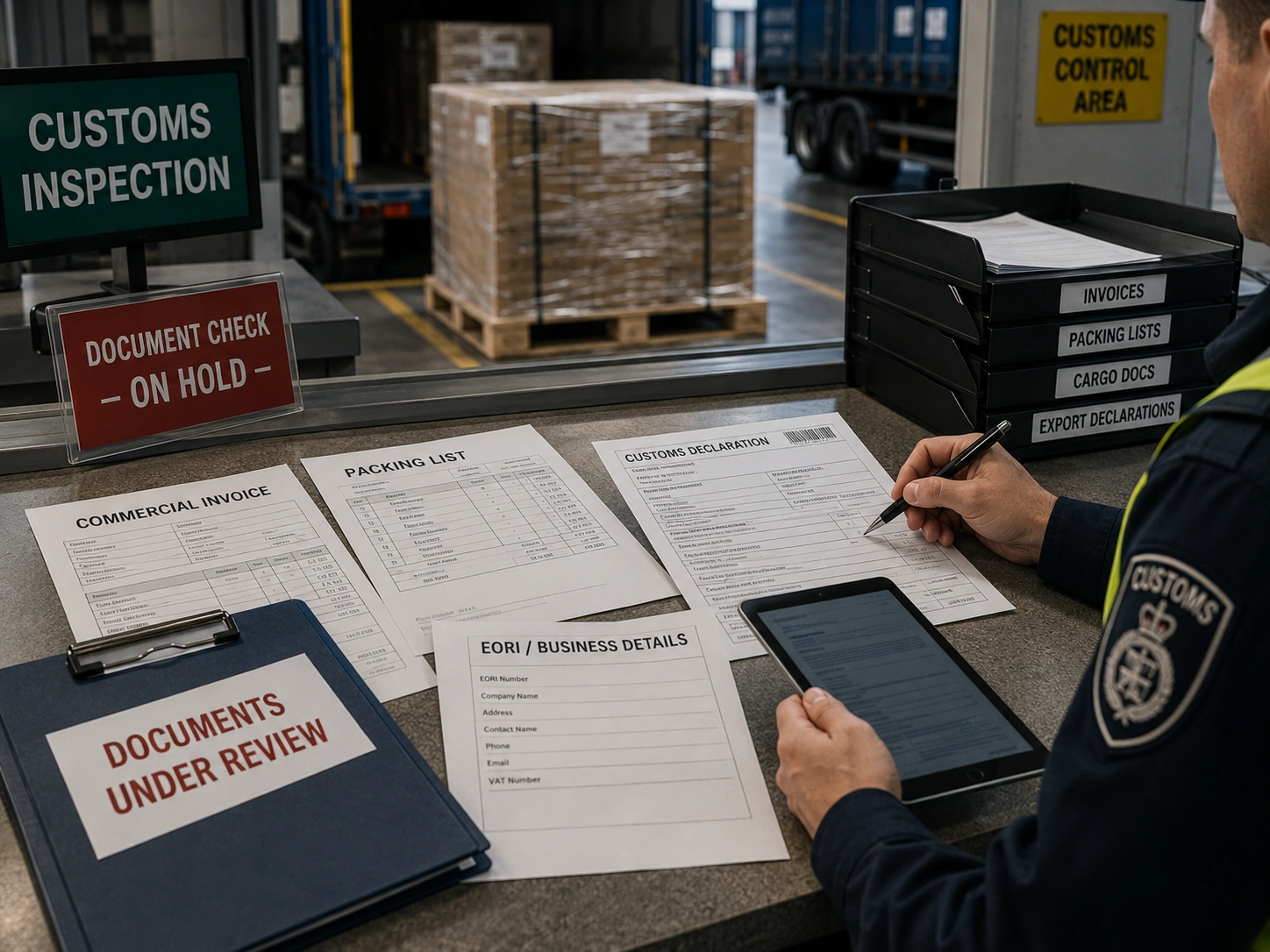
For an international shipment, the booking information, commercial invoice, packing list and customs declaration should tell the same basic story. If one document describes five cases of machinery parts while another shows four cases of "samples", the discrepancy may lead to further questions.
Common forms of pallet freight misdeclaration
Inaccurate pallet weight
The declared weight should normally be the gross weight of the complete shipment. That means the goods, pallet, cartons, wrapping, straps, protective materials and any other packaging.
Common errors include:
- declaring the product's net weight instead of the loaded pallet weight
- relying on a manufacturer's approximate specification
- forgetting the weight of packaging
- adding more goods after obtaining the quote
- estimating because suitable weighing equipment is unavailable
- deliberately entering a lower weight to obtain a cheaper service
A modest difference may lead to the shipment being re-rated. A larger difference can create handling and safety issues, particularly where the freight exceeds the capacity of the booked service, tail lift, pallet network or collection vehicle.
For example, a business might book a 450 kg pallet based on the weight of the products shown on a stock sheet. Once the timber pallet, boxes, corner protection and wrapping are included, the finished freight weighs 530 kg. The carrier may apply the correct rate, add a processing charge or refuse the freight if it is outside the service limits.
Incorrect pallet dimensions
Pallet dimensions should be taken from the furthest points of the completed, wrapped shipment, not simply from the pallet base.
Typical mistakes include:
- measuring an empty pallet rather than the loaded freight
- ignoring goods that overhang the edges
- measuring before the final cartons are added
- excluding protective packaging from the height
- forgetting that straps or irregular components increase the total size
- describing a pallet as stackable when freight cannot safely be placed on top of it
Dimensions matter because freight networks allocate space according to the complete footprint and height of the shipment. An oversized or non-stackable pallet may occupy substantially more vehicle and depot capacity than the booking suggests.
Vague, incomplete or false goods descriptions
A description such as "parts", "equipment", "materials" or "samples" may be understandable internally, but it does not necessarily tell a carrier or customs authority what is actually being shipped.
A useful description should normally identify what the item is, what it is made from and, where relevant, what it is used for. For example:
- Instead of "parts", use "steel replacement components for agricultural machinery".
- Instead of "samples", use "non-hazardous ceramic tile samples".
- Instead of "equipment", use "industrial label-printing machine with integrated lithium-ion battery".
A precise description supports commodity classification, safety checks and customs clearance. HMRC guidance is clear that goods must be described precisely enough to identify and classify them.
False descriptions are more serious. Describing new commercial goods as personal effects, disguising alcohol as food products or describing regulated chemicals as cleaning supplies can be treated very differently from an incomplete description that is promptly corrected.
Incorrect shipment or customs value
The customs value is not always the same as the amount shown in a basic sales quotation or the amount the sender would like to insure.
Depending on the transaction and the applicable rules, customs valuation may need to take account of matters such as the price actually paid or payable, packaging, commissions, assists or materials supplied by the buyer, royalties or licence fees, transport and insurance costs, and adjustments required under the relevant valuation method.
The rules vary according to the transaction and jurisdiction. For goods imported into the UK, HMRC's customs valuation guidance sets out six methods for establishing the value used to calculate Customs Duty and import VAT. The transaction-value method is considered first where it can be used.
Common problems include:
- entering the product's manufacturing cost instead of the correct customs value
- reducing the value to limit duty or tax
- using an arbitrary nominal figure
- declaring replacement goods as having no value
- treating commercial samples as automatically worth zero
- omitting relevant costs
- failing to provide evidence supporting the declared amount
The phrase "no commercial value" does not necessarily mean that goods have no customs value. Samples, warranty replacements and free-of-charge items may still require a realistic value for customs purposes.
An incorrect value may result in requests for invoices, contracts, payment evidence or revised calculations. It may also change the duty or import tax due.
Wrong commodity or HS code
Commodity codes are used to classify goods for customs purposes. They can affect duty and tax rates, import or export restrictions, licences and certificates, trade remedies, quotas, rules of origin and the information required on the customs declaration.
The UK Trade Tariff allows businesses to search for commodity codes and check the associated duty, VAT and licensing requirements. Classification can depend on the product's materials, function, construction, manufacturing process and packaging.
Mistakes often happen when a business:
- copies a code from an earlier shipment
- accepts a supplier's code without checking it
- uses a broad code based only on the product name
- assumes similar-looking products share the same classification
- selects the code with the lowest duty rate
For example, two electronic components may appear similar but be classified differently because one performs a distinct function or contains different materials.
Where the classification is uncertain, it should be checked before dispatch. Businesses importing into or exporting from Great Britain can also apply for an Advance Tariff Ruling, which provides a legally binding commodity-code decision for the goods covered. For goods imported into or exported from Northern Ireland, the Binding Tariff Information process applies where relevant.
Pallet2Ship can help customers understand the shipping process, but customers must provide complete and accurate product and customs information. Where a customs representative is appointed, legal responsibility depends on the type of representation, the services provided and the applicable customs rules.
Undeclared dangerous goods
Dangerous goods are not limited to drums of industrial chemicals. Everyday commercial products may fall within regulated categories, including lithium batteries, battery-powered machinery, aerosols, paints and varnishes, adhesives, solvents, compressed gases, cleaning products, flammable liquids and machinery containing residual fuel or oil.
Lithium batteries are classified as dangerous goods because they can create safety risks if they are not prepared and transported in accordance with the applicable rules.
Depending on the product and transport mode, dangerous goods may require correct classification and UN numbers, approved packaging, marks and hazard labels, a dangerous-goods transport document, quantity calculations, carrier approval, trained personnel and supporting technical information such as a current Safety Data Sheet where relevant.
Requirements also differ between road, air and sea transport. For air freight, the IATA Dangerous Goods Regulations — based on the ICAO Technical Instructions — provide the recognised operational framework used by airlines and handlers.
A business may fail to declare dangerous goods because it genuinely does not realise that its product is regulated. For instance, a piece of equipment may contain an integrated lithium battery that the shipping team did not know about.
That is different from deliberately concealing the battery or changing the description because the original service would not accept it. Both situations may stop the shipment, but deliberate concealment is likely to be treated more seriously.
We consider dangerous-goods enquiries on a case-by-case basis and ask business customers to provide appropriate information, including safety documentation where relevant. Acceptance is not automatic, and not every carrier or service can carry every class of dangerous goods.
Incorrect country of origin
Country of origin is not necessarily the country from which the pallet is dispatched, the seller's country, the country where the goods were purchased or the location of the warehouse.
It refers to the goods' economic nationality, determined under the applicable rules of origin. In broad terms, this may be where the goods were wholly obtained or where their last substantial production or processing took place, but the precise rule depends on the product and trade arrangement.
Origin can affect whether preferential duty is available, standard tariff rates, import restrictions, sanctions, quotas, trade remedies and documentary requirements. Official UK export guidance explains that rules of origin determine the economic nationality of goods and can influence both duties and import restrictions.
A product shipped from a UK warehouse is therefore not automatically of UK origin. If it was manufactured overseas and has not undergone sufficient processing in the UK, a different origin may need to be declared.
Restricted or prohibited goods
A prohibited item cannot be transported under the relevant law, route or carrier terms. A restricted item may be carried only where specified conditions are met, such as obtaining a licence, using approved packaging or supplying additional documents.
Potential examples include controlled chemicals, medicines and medical products, food and animal-origin products, plants, seeds and timber, weapons and weapon components, counterfeit goods, sanctioned goods, cultural property, waste materials and products subject to export controls.
Restrictions may come from several places at once: the laws of the exporting country, the destination country's rules, transit-country requirements, customs and border controls, sanctions regimes and the carrier's own conditions.
An item being lawful to own or sell does not necessarily mean that it can be sent through a standard pallet service.
Pallet2Ship maintains a prohibited and restricted-items resource for goods that cannot be accepted or require further checks through its services. Customers should review the current requirements before booking rather than relying on assumptions from a previous shipment.
Why do businesses misdeclare freight?
Accidental misdeclaration
Many declaration problems are ordinary process failures rather than deliberate conduct.
Common causes include:
- booking before packing is complete
- estimating weight and dimensions
- copying details from an old shipment
- relying on incomplete supplier information
- misunderstanding customs terminology
- sales and warehouse teams using different product descriptions
- confusing product cost with customs value
- assuming samples or returns need minimal documentation
- failing to check whether a product contains batteries or chemicals
- selecting a commodity code based only on a general product name
A frequent example is a sales administrator arranging collection from the customer's order details while the warehouse is still preparing the pallet. Extra cartons are then added, the wrapping increases the dimensions and nobody updates the booking.
Although accidental, the information presented to the carrier is still inaccurate.
Deliberate misdeclaration
Deliberate misdeclaration may involve understating weight or dimensions to reduce freight charges, lowering the declared value to reduce duty or import tax, using an inaccurate commodity code to avoid controls, concealing dangerous goods, describing commercial products as gifts, samples or personal effects, or disguising prohibited, sanctioned or controlled items.
Authorities and carriers will usually distinguish between a reasonable mistake that is disclosed and corrected quickly and conduct intended to avoid charges or regulatory controls. Deliberate misdeclaration can expose the business and individuals involved to more serious enforcement action.
How are incorrect declarations detected?
A discrepancy can be identified at almost any stage of the shipment.
Carrier checks
Carriers and depots may use calibrated scales or weighbridges, automatic dimensional scanners, manual measurements, visual inspections, barcode and consignment records, photographs, handling-equipment data and comparisons with the original booking.
If the shipment is physically larger or heavier than declared, the issue may be identified as soon as it enters a depot.
Some discrepancies become apparent through handling. A pallet booked as stackable may have an uneven or fragile top. A shipment described as dry machine parts may leak liquid or carry hazard markings. A pallet booked within a network limit may be too tall to pass through automated equipment.
Customs and regulatory checks
Customs authorities may review the customs declaration, commercial invoices, packing lists, product descriptions, commodity codes, valuation evidence, origin documents, permits and licences, transport records and information from previous shipments. They may also use scanning equipment, physical examinations, risk profiling and intelligence from other authorities.
A shipment may attract attention because the declared value appears unusually low, the commodity code does not fit the description, the buyer's business appears inconsistent with the goods or the documentation contains conflicting quantities.
Checks do not always happen at the border. A discrepancy may be identified during export clearance, after import or through a later customs audit.
What happens when pallet freight is misdeclared?
The outcome depends on the type of error, the goods, the route, the carrier's terms and whether the problem can legally and operationally be corrected.
Re-rating and additional charges
Where the physical freight is heavier, larger or less stackable than booked, the carrier may re-rate it according to the correct specification.
Additional costs may include the difference in the freight rate, an incorrect-declaration or administration charge, oversize or overweight surcharges, non-stackable freight charges, additional handling, redelivery or recollection costs and storage while instructions are obtained.
Re-rating is not necessarily a penalty. In many cases, it is the carrier charging for the service and space that the shipment actually requires.
Collection failure or network delay
A driver may be unable to collect a pallet where it exceeds the booked weight or dimensions, the vehicle lacks suitable lifting equipment, it is unsafe or inadequately packaged, dangerous goods were not approved or the contents are prohibited under the service.
A shipment already inside the network may be held or removed from normal movement until the sender provides corrected details.
Customs queries and clearance delays
Where the declaration or supporting paperwork is unclear, customs or the clearance agent may request a revised commercial invoice, a more precise goods description, proof of payment, product specifications, evidence of origin, a corrected commodity code, permits or licences, or confirmation of the intended use of the goods.
Until the issue is resolved, the shipment may remain in storage and miss its expected delivery date.
Duty and tax adjustments
A corrected commodity code, value or origin may change the amount of duty or import tax payable. The authorities may require the underpaid amount to be settled before release. Depending on the circumstances, interest, administrative charges or penalties may also be considered.
Customs penalties
Customs penalties vary according to the jurisdiction and circumstances. Relevant factors may include the type of contravention, the amount of duty affected, whether reasonable care was taken, whether the mistake was disclosed voluntarily, whether it was corrected promptly, the business's compliance history and whether the conduct was deliberate.
HMRC maintains a civil-penalty framework for contraventions of customs and export requirements, including rules on who may be liable and how penalties are assessed. In practice, HMRC may issue a Civil Penalty Warning Letter or a financial civil penalty for customs contraventions. A criminal fine is different and would normally follow criminal proceedings.
An ordinary measurement mistake does not automatically produce a customs fine. Penalties are more relevant where customs obligations have been breached rather than where a carrier simply needs to correct a pallet's freight rate.
Return to sender or export refusal
If the goods cannot be cleared, accepted by the carrier or legally imported, they may be returned to the sender, refused for export, held pending further instructions or treated as abandoned if no lawful or economical solution is available.
Return transport, storage, handling and customs-administration costs may be charged to the responsible party under the applicable terms.
A return is not always possible. Some goods cannot legally re-enter the country of dispatch, cannot be moved safely or require authorisation before any further transport.
Insurance and compensation problems
Incorrect declarations can make a loss or damage claim more difficult. For example, the goods may have been described too vaguely to prove what was shipped, the declared value may not match the amount claimed, the weight may be inconsistent with the alleged contents, dangerous goods may have been sent in breach of the policy or carrier terms, or the service used may never have been suitable for the actual item.
This does not mean that every error automatically invalidates insurance. The effect will depend on the policy, carrier terms, nature of the inaccuracy and whether it contributed to the loss. However, accurate records make it much easier to establish the contents, condition and value of a shipment.
Seizure, forfeiture or destruction
Seizure is a more serious outcome and is not the normal response to a simple booking error.
It is also worth distinguishing detention from seizure: detention is the temporary holding of goods while checks are carried out, whereas seizure means the goods are taken as liable to forfeiture. Detention may end with the goods being released once the checks or queries have been resolved, depending on what the authorities find.
It is more likely where the shipment involves prohibited or controlled goods, counterfeit products, sanctions or export-control breaches, concealed dangerous goods, serious customs offences, unlawful imports or exports, or goods that cannot safely or legally be released.
UK customs law provides powers concerning the detention, seizure and forfeiture of goods in relevant circumstances, including offences involving prohibited or restricted exports.
Goods may sometimes be destroyed where they are unsafe, contaminated, prohibited, perishable or unsuitable for lawful return. The outcome depends on the authority involved and the specific legal basis for action.
An incorrect pallet height will not ordinarily lead to goods being destroyed. Undeclared hazardous chemicals or prohibited animal products could present a very different situation.
Wider commercial consequences
The direct carrier or customs charge may be only part of the cost. A delayed or returned pallet can also cause missed customer deadlines, interrupted production, lost sales, emergency replacement shipments, storage costs, additional administrative work, reputational damage, greater scrutiny of future declarations and loss of customer confidence.
For a smaller business, a single shipment may represent an important customer order or a large proportion of available stock. Avoiding preventable declaration errors is therefore as much an operational issue as a customs one.
What should you do if you discover an error?
Act as soon as possible.
- Do not ignore the discrepancy. A small error is unlikely to resolve itself once the pallet enters the network.
- Contact Pallet2Ship or the relevant shipping provider. Explain whether the pallet is awaiting collection, already collected or held at customs.
- Identify precisely what is wrong. State whether the issue concerns weight, dimensions, contents, value, classification, origin or dangerous goods.
- Provide corrected information. Supply new measurements, photographs, invoices or product details where needed.
- Ask whether movement should be paused. The shipment may need to be held until the correct service or approval is arranged.
- Check whether customs information can be amended. The procedure will depend on the declaration's status and the authority involved. Some declaration systems permit certain corrections, but amendments are not always available at every stage.
- Provide supporting evidence promptly. This might include proof of value, product literature, a safety data sheet or origin documentation.
- Follow specialist instructions. Do not attempt to resend dangerous or restricted goods through another standard service without addressing the underlying issue.
- Keep a record. Retain the corrected documents, correspondence and internal explanation.
Errors are generally easier to manage before collection or customs presentation than after the freight has travelled through several depots or crossed a border.
How to prevent freight misdeclaration
Before confirming a pallet booking:
- Finish packing the pallet before taking final measurements.
- Weigh the complete loaded pallet, including all packaging.
- Measure the longest, widest and highest points.
- Include overhang, wrapping, straps and protective materials.
- Confirm whether the top can safely support other freight.
- Count the pallets, cartons and individual packages.
- Describe the contents precisely.
- Confirm what each product is made from and used for.
- Check the commodity code against the actual product.
- Establish the correct customs value.
- Confirm the correct country of origin.
- Check for batteries, aerosols, liquids, fuel, chemicals and pressurised components.
- Review prohibited and restricted-goods requirements.
- Obtain licences, permits or certificates before dispatch.
- Make sure the booking, invoice, packing list and customs documents are consistent.
- Keep product specifications and supporting records.
- Ask for guidance before booking where anything is uncertain.
A reliable process is to have the warehouse confirm the physical information and the finance, sales or export team confirm the commercial and customs details.
What we can and cannot control
To keep responsibilities clear, it is worth setting out where our role begins and ends. We can help you understand what information a shipment normally requires, guide you through the booking process, and review the available options where freight is unusual, hazardous, oversized or subject to additional controls.
Pallet2Ship relies on the shipment information supplied by the customer and cannot independently verify the contents of a packed pallet. Customers remain responsible for providing complete and accurate information, while the precise legal responsibilities for a customs declaration depend on the parties' roles and the form of customs representation used. Carriers and customs authorities act on the information they are given — and so do we. Complete and accurate information substantially reduces the risk of re-rating, failed collection and customs delays.
Getting the declaration right before collection
Much freight misdeclaration is preventable.
The safest approach is to measure and weigh the pallet only after packing is complete, use a precise description of the goods, verify the customs value and commodity code, confirm the correct origin and identify any dangerous or restricted contents before booking.
A minor discrepancy found before collection may require only an updated quotation or corrected document. The same discrepancy found at a depot or border can be considerably more disruptive.
Pallet2Ship helps UK businesses arrange domestic and international pallet transport through a network of national and international carriers. Where a shipment is unusual, hazardous, oversized or subject to additional controls, provide the full details before booking so that the available options can be reviewed.
You can then obtain an instant pallet delivery quote or contact our team where the shipment requires additional checks.
---
This guide is for general information only and does not constitute customs, tax, insurance or legal advice. Requirements vary by product, route and destination, and change over time. Shippers remain responsible for ensuring their shipments comply with all applicable regulations.
If you have any questions regarding our services,
tracking your parcel or advice, we're here