Ship with confidence. Ship with Pallet2Ship®
UK Pallet Delivery You Can Count On
Pallet2Ship arranges pallet deliveries to every UK postcode through the country's leading pallet networks, including Palletways, Pallex, and TPN. Whether you need a single mini quarter pallet collected next day or a full trailer load moved same day, our platform compares services, shows prices upfront, and lets you book in minutes — with no account, no contract, and no minimum volume — while benefiting from the same networks and service levels used by major UK manufacturers and retailers.
UK pallet delivery operates through shared distribution networks. Your pallet is collected, moved to a regional hub, consolidated with other freight heading in the same direction, and delivered to the destination depot for final delivery. This hub-and-spoke model keeps costs low while maintaining reliable transit times — typically next day for premium services and 2-3 working days for economy. For urgent or oversized freight that doesn't suit the network, dedicated vehicles and FTL services are also available.
Why UK Businesses Trust Pallet2Ship
- Instant online quotes - no account, no waiting
- Up to 75% cheaper than standard rates
- Next-day delivery, same-day collection, timed slots available
- Saturday delivery available in most areas
- Fully trackable services from collection to delivery
- Insurance cover up to £50,000, with upgrades available
- Top-tier carriers including, Palletways, Pallex, TPN, and Palletforce
- UK-wide coverage - every postcode, every city, every county
- No minimum shipping volumes required by most major carriers
Who Uses UK Pallet Delivery?
UK pallet delivery is used by businesses across every sector. Common users include manufacturers and engineering firms shipping parts between sites; wholesalers and distributors moving stock to trade customers; e-commerce businesses fulfilling large or heavy orders; automotive suppliers shipping engines, gearboxes, and body panels; construction companies moving tools, fixings, and materials; print and packaging companies distributing finished products; and food producers shipping ambient goods to warehouses and retailers.
Whether you ship once a month or fifty pallets a week, Pallet2Ship gives you access to the same carrier networks and pricing used by the UK's largest freight operations.
When Should You Ship a Pallet Instead of a Parcel?
Pallet delivery becomes more practical and cost-effective than parcel services when your shipment exceeds approximately 30 kg or is too large or awkward for standard parcel boxes, when you are sending multiple boxes that can be consolidated onto a single pallet base, when goods are fragile or heavy and need the stability of a pallet for safe transport, when you need to move industrial equipment, machinery, or automotive parts that don't fit parcel dimensions, or when you are shipping regularly and want to reduce per-unit costs by consolidating onto pallets.
If your shipment weighs under 30 kg and fits in a single box, our parcel courier services may be more suitable. For anything heavier, larger, or multi-box, pallet delivery is almost always the better option.
Pallet Sizes
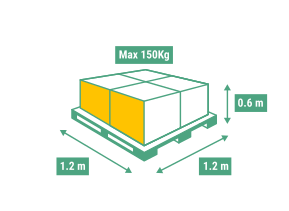
£44.59 + VAT
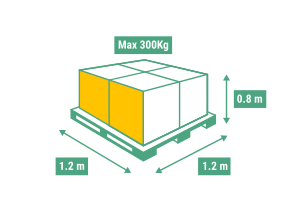
£47.07 + VAT
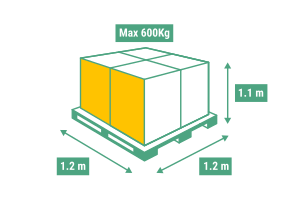
£49.04 + VAT
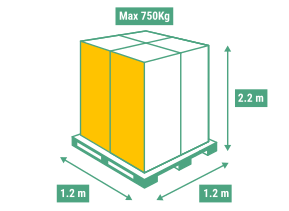
£49.04 + VAT
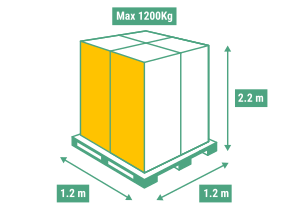
£51.85 + VAT
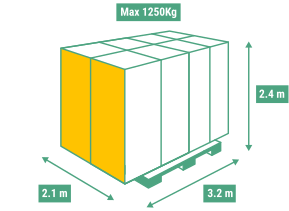
£92.17 + VAT
UK Coverage Section
Pallet2Ship delivers to every UK postcode. Our network covers England, Scotland, Wales, Northern Ireland, Isle of Man, Isle of Wight, and the Channel Islands.
For a detailed breakdown of collection and delivery locations, see our UK Pallet Collection and Delivery Locations page.
Deliveries to the Scottish Highlands, certain Scottish islands, Northern Ireland, Isle of Man, Isle of Wight, and Channel Islands may take slightly longer and may incur additional charges. These are clearly shown during the quote process.
Shipments between Great Britain and Northern Ireland may require customs details such as EORI numbers and commodity codes under the Windsor Framework. Our system flags these requirements during booking.
From First-Timers to Freight Pros
Never shipped a pallet before? No problem.
Run a growing operation with tight delivery windows? You're covered.
Pallet2Ship supports first-time shippers, e-commerce sellers, engineers, retailers, and wholesalers alike — all using our platform to get fast quotes and hassle-free booking in just a few clicks.
What We Ship Across the UK
- Small boxes and bulky parcels
- Single pallets, part loads (LTL), or full loads (FTL)
- Oversized pallets and irregular freight
- Business stock, engines, building materials, and personal effects (if palletised)
If it fits on a pallet, we can move it.
Designed for Busy People
Our platform is made for business owners — not freight experts. That's why:
- Get instant quotes and book in under 2 minutes
- See real-time prices with no login required
- Track your delivery from collection to arrival
- Speak to a real person — not a chatbot
- Register for faster booking and bulk shipment tools
- Cashback for volume senders - earn up to 10% back every month
Get Your Free Quote and Book in Seconds
No contracts. No minimums. No nonsense.
Just fast, trackable, affordable pallet delivery to every UK postcode - backed by people who care.
Try it now — get your instant UK pallet delivery quote and see the difference.
Case Studies about pallet delivery within the UK
Quick Summary
Key Facts
- Route: Birmingham to Manchester
- Origin: Birmingham, UK
- Destination: Manchester, UK
- Mode: Dedicated vehicle (same-day)
- Goods: Critical manufacturing spare parts
- Issue: Production line shutdown requiring immediate parts delivery
- Resolution: Dedicated vehicle arranged for same-day collection and delivery
What Happened
What the Customer Did Right
- Contacted us immediately and clearly communicated the urgency and operational impact
- Provided accurate collection and delivery details without delay
- Ensured goods were packed, palletised, and ready for immediate collection
- Confirmed access and handling requirements at both the Birmingham and Manchester sites
What Went Wrong
- Standard pallet network services operate on next-day schedules and cannot accommodate same-day delivery
- The critical parts were held at a separate facility with no scheduled transport in place
- Every additional hour of downtime carried significant financial cost based on the facility’s hourly production output
How Pallet2Ship Resolved It
- Vehicle sourced within minutes of the booking being confirmed
- Collection arranged within 2 hours of the initial enquiry
- Direct point-to-point transport with no hub handling, consolidation, or intermediate stops
- Continuous communication maintained with both the Birmingham and Manchester sites throughout the journey
Results
- Same-day delivery completed within 6 hours of the initial enquiry
- Estimated 18–24 hours saved compared to standard pallet network delivery
- Production downtime limited to the same working day
- Estimated £15,000+ in lost production avoided, based on the customer’s stated hourly production output value
What to Do vs What Not to Do
 Do This
- Use dedicated vehicles for urgent, time-critical shipments where same-day delivery is essential
- Contact the team immediately when downtime is ongoing — delays in booking extend delays in delivery
- Have goods packed, palletised, and ready for collection before the vehicle arrives
- Provide full and accurate shipment details at the point of enquiry so the vehicle can be sourced immediately
 Don't Do This
- Rely on next-day pallet networks for emergency or same-day situations — they are not designed for this
- Delay the booking decision while downtime costs accumulate
- Assume all freight services operate on the same timelines — dedicated transport and network services are fundamentally different
Why It Matters
Quick Summary
Key Facts
- Route: Nationwide (England & Scotland)
- Origin: Midlands warehouse, UK
- Destination: Multiple distribution hubs
- Mode: Pallet network (LTL)
- Goods: Retail / e-commerce stock
- Issue: High shipping costs and inefficiencies with parcel-based distribution
- Resolution: Transition to pallet network with consolidated weekly shipments
What Happened
What the Customer Did Right
- Conducted a cost review that identified the parcel-to-pallet crossover point
- Made the decision to transition before costs escalated further
- Standardised their packaging and pallet dimensions for consistency
- Set up an account for repeat bookings and operational efficiency from day one
What Went Wrong
- Shipments were being handled as individual parcels rather than consolidated onto pallets
- The volume had grown beyond the point where parcel services were cost-effective
- Multiple handling points across 40–60 individual parcels per week increased the risk of damage
- Admin time for booking, tracking, and managing fragmented consignments was significant
How Pallet2Ship Resolved It
- Consolidated 40–60 weekly parcels into 8–12 pallets per week
- Set up the account with repeat booking tools so weekly shipments could be placed in minutes
- Provided access to nationwide pallet network coverage through Palletways, Pallex, and TPN
- Enabled predictable next-day delivery across all key UK routes
- First week’s pallet costs came in at approximately 35% below the equivalent parcel costs for the same volume and destinations
Results
- 35% cost reduction compared to individual parcel shipments, based on the customer’s comparable parcel and pallet shipping costs over the same routes and volumes
- Consistent next-day delivery across most UK routes
- Reduced damage rates due to palletisation and fewer handling points
- Significant time savings in booking and administrative processes
- Transition completed within one working week with no disruption to deliveries
What to Do vs What Not to Do
Do This
- Review your shipping costs regularly — if you are sending more than 10–15 parcels per week to the same destinations, palletisation is almost certainly cheaper
- Consolidate shipments onto pallets to reduce cost per unit and handling points
- Set up an account and use repeat booking tools for operational efficiency
- Standardise your pallet dimensions and packing for consistent pricing
Don't Do This
- Continue using parcel services for bulk freight once volume exceeds the crossover point
- Ship multiple fragmented consignments to the same destination when they could be consolidated
- Ignore rising per-unit costs as shipment volume grows — the savings from switching to pallets increase with volume
Why It Matters
Quick Summary
Key Facts
- Route: Yorkshire to South East England
- Origin: Engineering workshop, Yorkshire, UK
- Destination: Client installation site, South East England
- Mode: Dedicated vehicle
- Goods: Industrial engineering equipment (240 cm height, approximately 800 kg)
- Issue: Equipment exceeded standard pallet network height restrictions
- Resolution: Dedicated vehicle arranged with forklift handling at both ends
What Happened
What the Customer Did Right
- Provided accurate dimensions including the full loaded height before attempting to book
- Contacted our team when the network booking was flagged, rather than trying to force the shipment through
- Confirmed forklift availability at both the Yorkshire workshop and the South East client site
- Secured the equipment properly to a custom pallet base with ratchet straps and corner protection
What Went Wrong
- The equipment’s height exceeded the 220 cm pallet network limit by 20 cm — close enough to appear borderline, but operationally impossible for hub-based handling
- The weight (approximately 800 kg) required forklift handling at both ends — tail-lift was not an option
- The client site had specific access constraints that needed confirming before dispatch
- Any delay would have affected the client’s installation schedule
How Pallet2Ship Resolved It
- Vehicle matched to the equipment’s dimensions and weight — no height restrictions, no hub handling
- Direct point-to-point transport from the Yorkshire workshop to the South East client site
- Forklift loading confirmed at the workshop and forklift unloading confirmed at the client site before the vehicle was dispatched
- Pre-dispatch checks validated the full loaded dimensions, total weight, pallet base integrity, and access at both locations
- Driver briefed on the handling requirements — no tilting, no stacking, controlled loading and unloading
Results
- Shipment completed same day without rebooking, delays, or handling issues
- Avoided a failed collection and wasted journey charge that would have occurred if the shipment had been sent through the pallet network
- Estimated 1–2 working days saved compared to rebooking through the correct service after a failed network collection
- Zero handling damage due to controlled, direct transport with confirmed forklift handling at both ends
- Client’s installation schedule maintained without disruption
What to Do vs What Not to Do
Do This
- Measure the full loaded height of your pallet including the pallet base, packaging, and any overhang — 220 cm is the standard network maximum
- Use dedicated transport for any shipment exceeding standard pallet network dimensions
- Confirm forklift or appropriate handling equipment is available at both collection and delivery before booking
- Check access at the delivery site — particularly for client premises, construction sites, or locations you haven’t shipped to before
Don't Do This
- Book oversized freight on standard pallet networks assuming it will be accepted — it won’t, and you’ll pay a wasted journey charge
- Estimate dimensions instead of measuring — a 20 cm difference between 220 cm and 240 cm is the difference between a network pallet and a dedicated vehicle
- Ignore loading and unloading requirements — if forklift handling isn’t available at both ends, the shipment cannot proceed
Why It Matters
Frequently asked questions
about shipping services to and from the UK
Quotes & Pricing
Transit Times & Services
Pallet Sizes & Specifications
Packing & Preparation
What Can I Ship?
Collection & Delivery
Insurance & Protection
Service Types & Carriers
Booking & Changes
Practical Considerations
How to Send a Pallet in the UK | Fast, Reliable & Affordable Delivery with Pallet2Ship
UK Pallet Delivery - Pallet2Ship
Pallet2Ship — your one-stop shop for all your transport needs
Create your export and import documents — including Commercial Invoices — directly through our online platform once your booking is complete.
All documents are saved automatically to your Pallet2Ship account, with clear step-by-step instructions sent by email. Whether you're a regular shipper or booking for the first time, everything you need is in one place, and our UK-based team is always ready to help.