The latest Industry News
Shipping oversized pallets can be straightforward when the shipment is
prepared properly and the right transport is arranged. But when dimensions
are wrong, packing is unsafe, or handling requirements are not declared,
carriers may refuse collection, apply surcharges, or require special
handling before the freight can move.
For businesses sending large or heavy goods, these issues lead to delays,
unexpected costs, and missed deliveries. This guide explains what counts
as an oversized pallet, the point at which freight stops being standard
pallet freight, the real size limits that apply, why oversized shipments
cost more, and how to prepare large freight correctly the first time.
What is an oversized pallet?
An
oversized pallet
is any palletised shipment that exceeds a carrier's standard handling
dimensions or weight limits. A standard full pallet typically sits on a
120 x 100 cm base, up to around 220 cm in height, and up to roughly
1,000-1,200 kg including the pallet. Once a shipment goes beyond those
limits, it is treated as oversized.
A pallet may be classed as oversized because it is too tall, unusually
heavy, overhangs the pallet edges, takes up more than one pallet space,
cannot be safely stacked, or simply requires specialist handling.
Oversized freight is common for machinery, furniture, construction
materials, industrial equipment, and large commercial orders.
In the freight industry, awkward oversized loads are sometimes called
“ugly freight” — not an insult, just a recognition that they need more
thought, more space, and more careful handling than a neat, stackable
standard pallet.
When oversized freight stops being standard pallet freight
This is the single most important thing to understand about large
shipments, and it is where most businesses run into trouble.
Standard pallet networks are built around freight that can move safely and
efficiently through depot hubs using standard forklifts, pallet trucks,
and trailer configurations. A pallet is loaded, sorted through one or more
hubs, and delivered, often passing through several handling points along
the way. That system works brilliantly for freight that fits the mould.
Once a shipment becomes too large, too heavy, too long, unstable, or
impossible to stack safely, it may no longer be suitable for standard
network handling. Standard depot forklifts, loading bays, and trailer
layouts are all designed around predictable pallet dimensions, which is
why unusually long or awkward freight quickly creates operational handling
issues. At that point the freight often needs a dedicated vehicle, direct
transport rather than hub-to-hub routing, specialist loading arrangements,
forklift loading and unloading, or pre-approved oversized handling.
This is the crossover point that catches people out: the freight itself
may be perfectly transportable, just not through a standard pallet
network. Recognising which side of that line your shipment falls on —
before you book — is what prevents refused collections and re-rated
shipments.
How large can an oversized pallet actually be?
The honest answer is that it depends on the route, the transport mode, the
vehicle type, the loading facilities available, and whether the shipment
moves through a pallet network or via dedicated transport. As a general
operational guide, here is what is achievable by route and mode.
UK, Great Britain, Northern Ireland and Republic of Ireland
On a dedicated vehicle basis, oversized freight can often be accommodated
up to approximately **600 cm length, 240 cm width, and 220 cm height**.
These shipments normally require forklift loading and unloading,
curtainsider trailer access for side-loading, and suitable loading
facilities at both collection and delivery. They are arranged on a
quotation basis rather than
booked instantly online, so the correct vehicle and handling method can be confirmed in advance.
Europe
European
oversized freight can often move at broadly similar dimensions on request,
though practical limits are sometimes slightly lower depending on the
route, trailer availability, and cross-border handling. As with UK
movements, the customer normally needs the facilities to load and offload
a curtainsider at both ends.
Sea freight
Sea freight
can usually accommodate significantly larger and heavier freight than road
or air. Typical oversized sea handling may allow approximately 585 cm
length, 233 cm width, and 229 cm height, depending on container
configuration, loading method, route, and carrier approval. For genuinely
large or heavy items, sea freight is often the most practical option.
Air freight
Air freight
is the most restrictive for oversized cargo, because aircraft loading
doors and cargo hold dimensions are limited. As a practical guide, height
usually needs to remain below roughly 160 cm, although very long freight
can sometimes move on freighter aircraft. Oversized air freight almost
always requires individual assessment and pre-approval before booking,
based on dimensions, weight, route, and aircraft availability.
These figures are operational guidance, not guarantees. Every oversized
shipment should be confirmed before booking, because the right answer
depends on the specific goods, route, and facilities at each end.
Why forklifts and loading facilities matter
For oversized freight, how the pallet is loaded and unloaded is often more
important than the dimensions themselves. This is the detail most
businesses underestimate.
Standard pallet collections can sometimes use a tail-lift, where the
pallet is raised on a platform at the back of the vehicle and moved with a
pallet truck. But oversized and long freight frequently cannot be handled
this way. A long pallet cannot be safely turned or positioned on a
tail-lift or pallet truck without risking twisting, tipping, or damage.
Instead, these loads are usually side-loaded into a curtainsider using a
forklift.
That has a practical consequence: for most oversized movements, the
customer needs their own forklift and suitable loading facilities at both
collection and delivery. If there is no way to load or offload the
curtainsider safely at either end, the collection can fail or the shipment
may need rebooking on a different basis. Where forklift access genuinely
is not available, a crane or truck-mounted lift can sometimes be arranged
on request — but this must be declared and agreed before booking, not
discovered on the day.
The key point is simple: declare your loading situation honestly and
early. Whether you have a forklift, whether the site is a business with a
yard or a restricted residential address, and whether the trailer can be
accessed safely all determine which vehicle and method are assigned.
The tail-lift misunderstanding
It is worth addressing one assumption directly, because it causes a lot of
failed collections.
Many businesses assume a tail-lift vehicle can handle any oversized
pallet. It cannot. Tail-lifts have their own weight and size limits, and
they are designed for freight within a standard footprint. A pallet that
is very heavy, very long, or carries a high or uneven centre of gravity
may be unsafe on a tail-lift even if it fits on the platform — there is a
real risk of the load tipping during the lift. Long and heavy oversized
freight typically needs forklift handling regardless of whether a
tail-lift is technically present.
If you are not certain whether your shipment can be tail-lift handled,
treat that uncertainty as a reason to declare it and ask, rather than
assume.
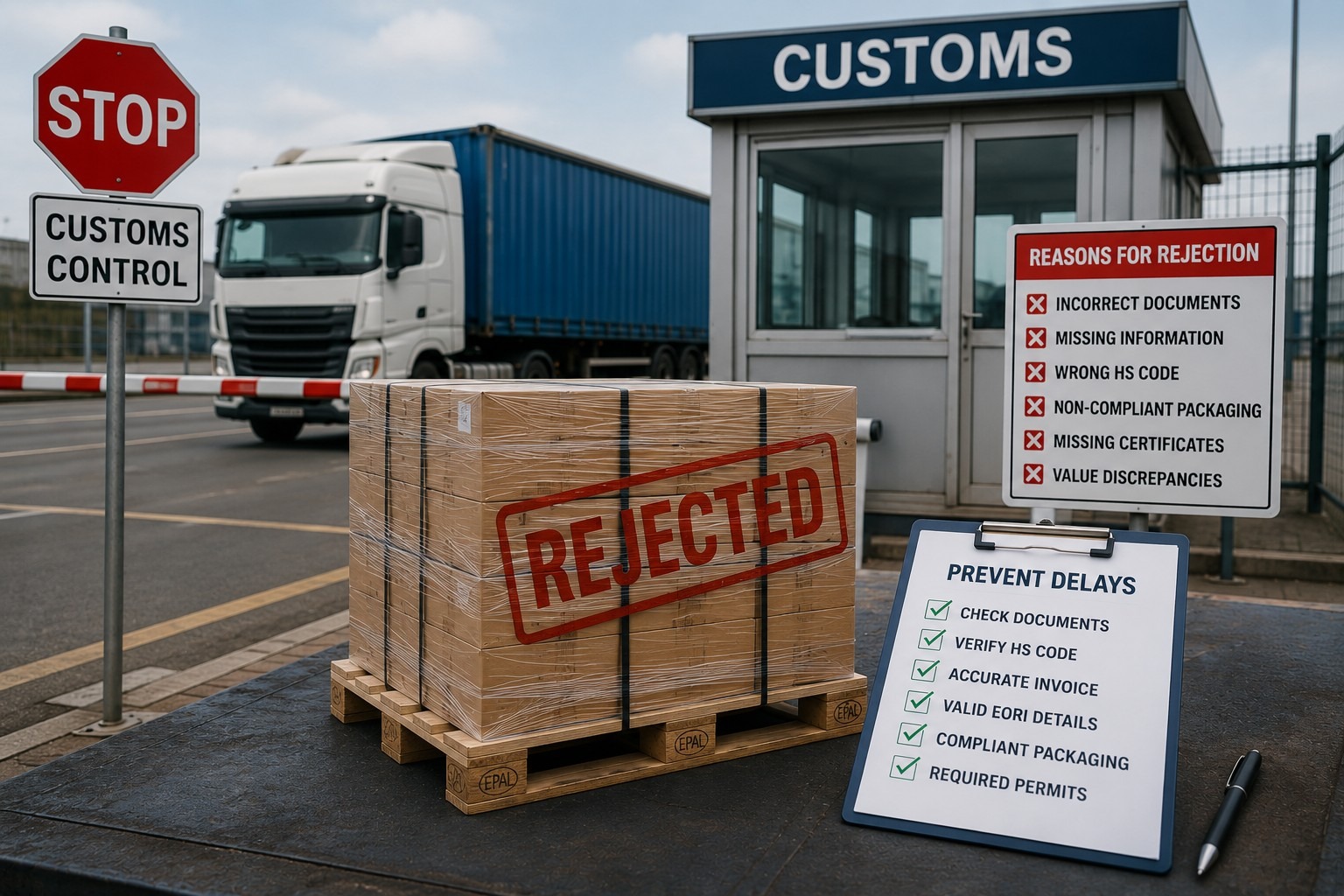
Why oversized pallets can be refused
Oversized freight is not automatically a problem, but carriers will refuse
shipments that cannot be moved safely or efficiently. The most common
reasons are worth understanding.
Incorrect dimensions or weight. Underdeclaring size or weight is
one of the biggest causes of failed collections. If the figures are wrong,
the wrong vehicle may be sent, there may not be enough trailer space, or
the depot equipment may be unsuitable. Many depots routinely reweigh or
remeasure freight when the dimensions appear inconsistent with the
booking, so inaccurate figures tend to surface anyway. Always measure the
pallet after it has been fully packed and wrapped — including height, full
footprint, any overhang, and accurate weight — not before.
Unsafe or unstable packing. Oversized pallets must stay stable
through collection, transit, and delivery. Carriers may refuse pallets
that lean, wobble, contain loose items, are top-heavy, sit on a damaged
base, or shift when moved. If it cannot be handled safely with a forklift,
it may not be accepted.
The shipment exceeds handling limits. Some freight is simply too
large or heavy for a particular service. Extremely tall pallets,
extra-heavy machinery, awkward or uneven loads, and items with excessive
overhang may need a different transport method entirely.
No lifting facilities available. As covered above, if there is no
forklift or suitable loading equipment at collection or delivery, an
oversized shipment may be delayed or refused.
Why oversized freight costs more
Surcharges on oversized freight are not arbitrary. They reflect real
operational costs, and understanding them makes the pricing far easier to
accept.
Oversized pallets take up more trailer space, and often more than one
pallet space, which reduces how much other freight the vehicle can carry.
They are almost always non-stackable — nothing can be placed on top of
them — so the space above them is effectively lost too. Standard network
trailers are planned around stackable pallet space, so extremely tall or
non-stackable freight reduces usable capacity more than its footprint
alone suggests. They require more planning, sometimes a dedicated vehicle,
and specialist equipment such as forklifts or curtainsiders. They carry
more manual handling risk and take longer to load and secure safely.
Each of those factors costs the carrier something, and that is what a
surcharge represents: the genuine additional cost of moving freight that
uses more space, more equipment, and more time than a standard pallet.
A related point is re-rating. If the actual dimensions or weight differ
from what was booked, the shipment is very likely to be re-rated to
reflect its true size — which is why accurate measurement before booking
protects you from unexpected charges later.
When a dedicated vehicle is the better option
Sometimes the most reliable and cost-effective answer is to skip the
pallet network entirely and use a
dedicated vehicle. This is often the better choice when freight is over roughly 220 cm
tall, very long, non-stackable, or carries an awkward centre of gravity,
as well as for fragile machinery that should not be repeatedly handled
through hubs, and for time-sensitive shipments where a direct route
matters.
A dedicated vehicle goes straight from collection to delivery without
passing through sorting hubs, which means less handling, lower damage
risk, and more predictable timing. For genuinely large or sensitive
freight, that direct approach frequently works out better all round than
forcing the shipment through a network it was never designed for.
What happens if there is a problem with the shipment
If an oversized pallet cannot move safely, the carrier may refuse
collection, delay the shipment, apply additional charges, re-rate the
pallet, request more handling information, return the shipment, or require
rebooking on a different service. Almost all of these outcomes are
avoidable when the shipment details are accurate and the freight is
prepared correctly from the start.
How to prepare oversized pallets properly
Good preparation
is the best defence against delays, damage, and unexpected charges.
Use a strong pallet. Oversized freight needs a pallet capable of
supporting the full weight safely. Avoid cracked boards, damaged feet, and
lightweight pallets — heavy-duty pallets are usually the right choice for
large goods.
Distribute weight evenly. Uneven weight causes leaning,
instability, and forklift handling problems. Keep heavier items low, keep
the centre of gravity stable, and minimise movement within the load.
Wrap and secure firmly. Oversized pallets are handled repeatedly,
so they need to withstand it. Use shrink wrap, strapping, banding, and
corner protectors as appropriate. The load should feel solid and secure
when moved.
Keep goods within the footprint where possible. Some overhang may
be accepted, but excessive overhang increases the risk of impact damage,
instability, and refused collection. Where overhang is unavoidable, always
declare it at booking — it changes how the pallet occupies vehicle space
and is never simply rounded down.
Label clearly. Labels should be visible, securely attached, and
protected from damage in transit.
Photograph before collection. Clear photos of the packed pallet
help resolve any later dispute over packaging condition, stability,
declared dimensions, or damage, and demonstrate that the shipment was
prepared properly.
What we can and cannot control
To keep responsibilities clear, it is worth setting out where our role
begins and ends. We can help you identify the right service for oversized
freight, arrange the correct vehicle and handling method, and guide you
through preparing and declaring the shipment properly.
What we depend on from you is accurate information and suitable
facilities. For most oversized movements, the customer needs their own
forklift and the ability to load and offload a curtainsider at both
collection and delivery. We also rely on accurate dimensions, weights, and
handling details to assign the right vehicle. When that information is
complete and the facilities are in place, oversized freight moves
smoothly. When it is not, the most likely outcomes are delays, re-rating,
or a failed collection — which is exactly what good preparation avoids.
Oversized pallet checklist
Before booking oversized freight, check that you have:
measured the pallet after wrapping (height, footprint, and any overhang)
- confirmed the accurate total weight
- declared any overhang
- confirmed whether the goods are stackable
- used a strong, undamaged pallet
- secured the load properly with wrap or strapping
confirmed forklift and loading facilities at both collection and
delivery
- declared any access restrictions or residential delivery
- photographed the shipment after packing
A few extra minutes at this stage prevents refused collections, re-rating,
and unexpected charges later.
Final thoughts
Oversized pallet shipping does not need to be complicated, but it does
require proper preparation and honest information. Most problems happen
when dimensions are wrong, pallets are packed unsafely, handling
requirements are not declared, or freight is booked through a service that
was never designed to carry it.
With accurate measurements, secure packing, the right transport, and clear
communication about loading facilities, oversized pallets move safely and
efficiently. If you are unsure whether your shipment qualifies as
oversized, or which service is right for it, it is always better to share
more information upfront than to risk delays or extra charges later.
At Pallet2Ship, we work with businesses of all sizes to
move large and oversized freight
safely and reliably. Whether you are shipping a single oversized pallet or
managing regular large freight movements, our team can help you find the
right solution — from standard oversized handling through to dedicated
vehicles for the largest loads.
If you have any questions regarding our services,
tracking your parcel or advice, we're here