The latest Industry News
If you ship goods internationally on pallets, ISPM 15 compliance is one of the most common – and most avoidable – causes of shipment disruption. When consignments are delayed, queried, or reworked at depots, ports, or borders, the problem is often not the commercial paperwork. It is the physical packaging.
Typical failure points include pallets that are not correctly treated, not correctly marked, repaired without control, contaminated, damaged, or technically compliant but with the stamp hidden under wrap or labels.
Pallet2Ship is a UK-based pallet shipping platform that arranges pallet deliveries by road, sea, and air for businesses shipping to and from the United Kingdom, as well as for international customers exporting to or importing from major trading partners such as the European Union and the United States. Across pallet networks, consolidation hubs, ports, and cross-border freight movements, we see the same ISPM 15-related problems again and again.
This guide is a practical checklist you can use to cut down on inspections, delays, rework, and avoidable costs when you ship internationally on pallets.
At a glance
- ISPM 15 applies to solid wood packaging material thicker than 6mm used in international trade.
- It requires debarked wood; only small residual pieces of bark within strict limits are allowed.
- It covers pallets, crates, collars, dunnage, and timber blocking or bracing.
- Compliance means approved treatment, a valid IPPC mark, acceptable condition, and visible marks on at least two opposite sides.
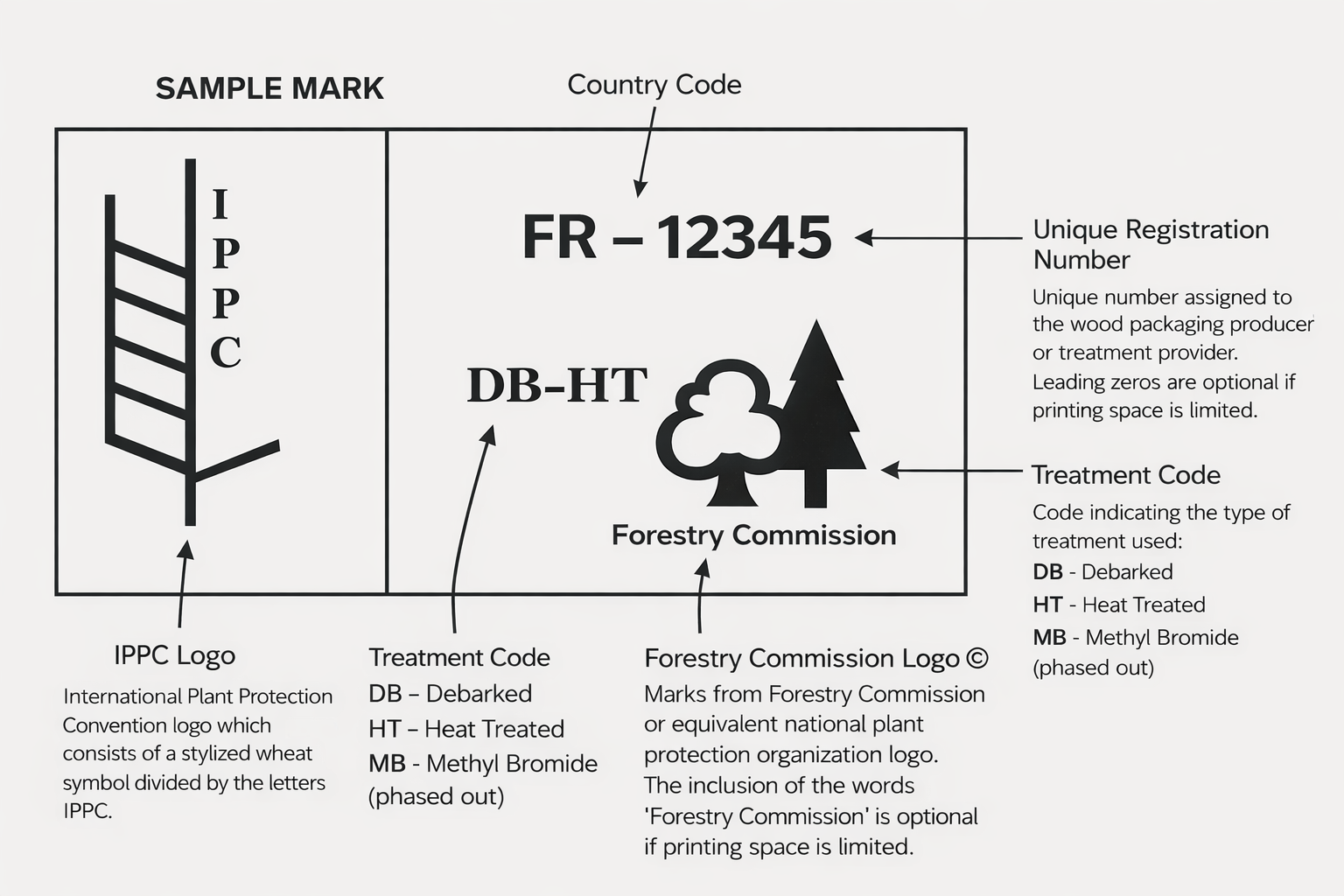
- Approved treatments are HT, MB, DH, and SF.
- Processed wood products such as plywood, OSB, and MDF, and plastic or metal pallets, are generally exempt.
- Reused export pallets can be acceptable, but uncontrolled repairs and mixed timber are frequent reasons for refusal.
- Empty pallets exported internationally must still be ISPM 15 compliant.
- The lowest-risk approach is a documented process covering approved suppliers, incoming inspection, packing rules, photo evidence, and route checks before dispatch.
What ISPM 15 is and why it matters
ISPM 15 is the international standard for using solid wood packaging material in international trade. Its purpose is biosecurity: untreated or poorly controlled wood can carry pests and organisms that survive transit and threaten forestry and agriculture.
In day-to-day operations, solid wood packaging is a common inspection trigger. That is why ISPM 15 compliance sits right at the point where your packing choices, carrier acceptance, and border clearance all meet.
Approved ISPM 15 treatment methods
- Only HT, MB, DH, or SF confer ISPM 15 compliance when they are properly applied and correctly marked.
- HT (heat treated) means the timber has been heated to a minimum core temperature of 56°C for at least 30 minutes. This is the most common and widely accepted method.
- MB (methyl bromide) was historically common but is now heavily restricted because of its environmental impact. It is still permitted in limited quarantine or pre-shipment situations in some countries.
- DH (dielectric heating) uses microwave or radio-frequency treatment. It is less common in everyday use, but valid when applied under an authorised scheme.
- SF (sulfuryl fluoride) is a newer fumigation method used in specific, authorised contexts.
- KD (kiln dried) by itself is not an approved ISPM 15 treatment. Only pallets marked with HT, MB, DH, or SF are compliant.
- If a pallet carries a valid IPPC mark with one of the approved treatment codes, it can be compliant. If the code is unclear, altered, or looks improvised, assume the pallet is a risk.
When ISPM 15 applies in practice
ISPM 15 applies to wood packaging material used in international trade. It does not normally apply to purely domestic movements within a single country, unless that country chooses to apply stricter rules.
In simple terms: if your shipment crosses an international border and uses solid wood packaging material thicker than 6mm, work on the basis that ISPM 15 compliance is required unless you are clearly using an exempt material.
ISPM 15 typically applies to:
- solid wood pallets, new or reused
- solid wood crates, cases, and pallet collars
- dunnage used to brace or protect goods
- timber blocking and bracing inside trailers or containers
- skids, bearers, and load boards
Common exemptions, which should still be checked before shipping, include:
- processed wood products such as plywood, OSB, MDF, and particle board
- wood components 6mm thick or less
- plastic or metal pallets and stillages
United Kingdom, Northern Ireland, and the European Union
This area causes a lot of confusion in practice, so it is worth being explicit.
- Shipments from Great Britain to the European Union
ISPM 15 applies to regulated solid wood packaging material. - Shipments from Great Britain to Northern Ireland
ISPM 15 applies, because Northern Ireland follows European Union plant health rules under the Windsor Framework. - Shipments from Northern Ireland to Great Britain
ISPM 15 does not apply. - Shipments from Northern Ireland to the European Union
ISPM 15 does not apply, as these are treated as movements within the EU single market.
Although ISPM 15 is a legal requirement for movements between Great Britain and the European Union, enforcement in practice is inconsistent, particularly on road freight and pallet networks. Many shipments move without inspection, but this tolerance should not be treated as an exemption. When checks do occur, non-compliant pallets can still be stopped, reworked, or charged. If you want peace of mind, packing as if an inspection may happen is the safest approach.
Compliance versus enforcement
ISPM 15 is a compliance requirement, not just a best-practice recommendation. What varies is how strictly it is enforced, depending on the route, commodity, and inspection point.
The safest way to run your operation is to prepare every international pallet shipment so that it can pass inspection quickly and without rework, even on stricter routes.
Risks of non-compliance
When ISPM 15 pallets or other solid wood packaging material are flagged, the fallout can be significant. Typical consequences include:
- shipment holds at depots or borders
- repacking or reworking onto compliant pallets
- refusal or re-export
- disposal or destruction of non-compliant timber
- storage, handling, and demurrage charges
- missed delivery slots and customer penalties
- commercial disputes and reputational damage
ISPM 15 issues cannot be fixed once the shipment has been collected. Compliance is built in at the packing stage.
How to identify a compliant ISPM 15 pallet
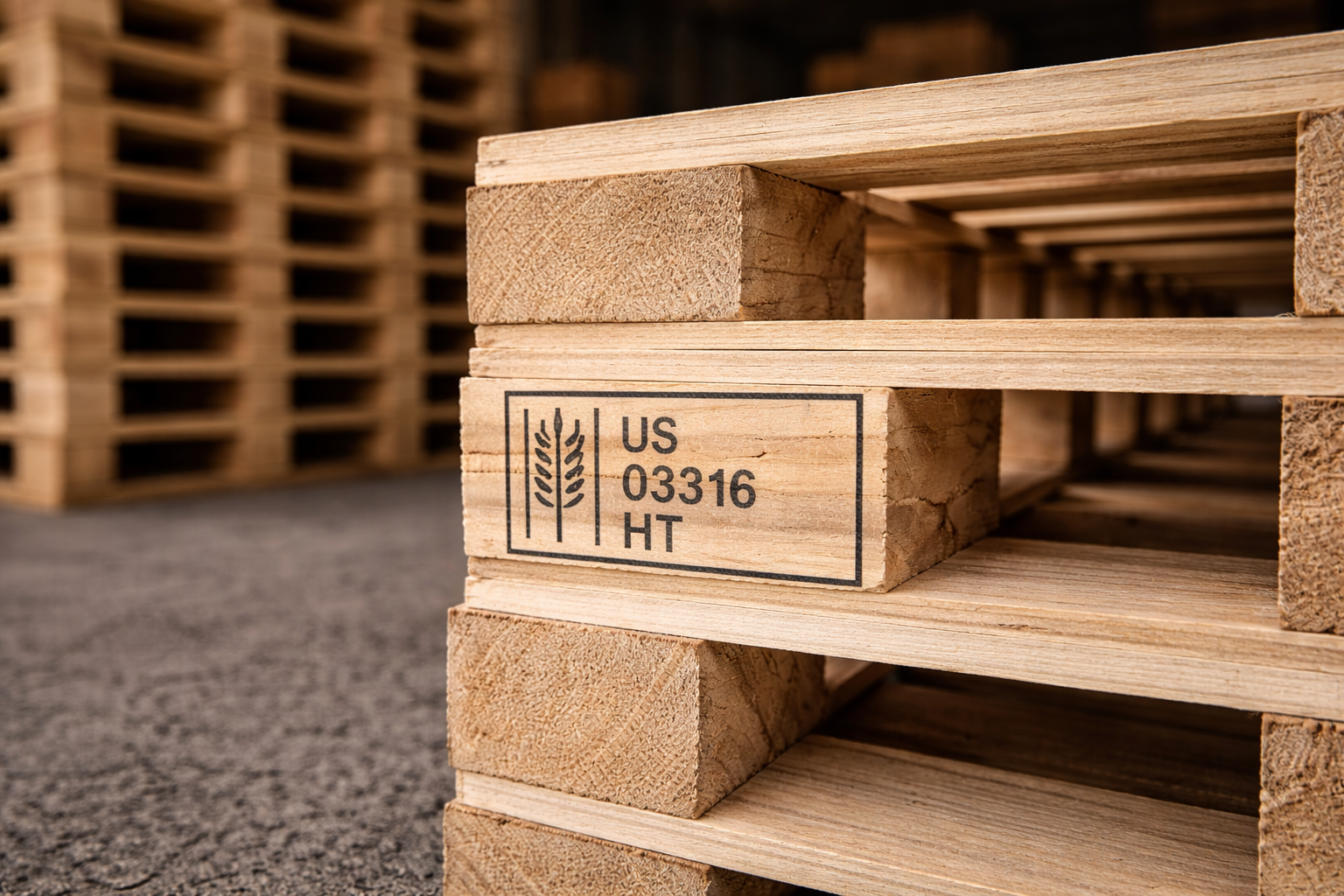
A compliant pallet must carry the official IPPC mark applied by an authorised facility, with the mark visible on at least two opposite sides. If you cannot clearly see a valid mark on two sides after packing, assume there is a problem and resolve it before collection.
Debarking rules
ISPM 15 requires debarked wood, but allows a limited amount of residual bark within strict tolerances:
- bark pieces less than 3cm wide are acceptable regardless of length
- bark pieces wider than 3cm are acceptable only if the total surface area is less than 50 square centimetres
Large bark patches, loose bark, or timber that looks untreated are red flags and should be avoided for export.
New versus reused export pallets
Both new and reused pallets can be compliant, but the risk profile is different.
New heat-treated pallets typically have clear stamps, cleaner timber, and no hidden repairs. They carry the lowest risk for time-critical or inspection-prone shipments.
Reused export pallets are often acceptable in principle, but carry higher risk due to faded marks, repairs, contamination, or mixed components. Quality varies widely between suppliers.
For high-value or time-sensitive lanes, it usually pays to choose new or top-grade reused pallets rather than the cheapest available option.
Pallet repairs
If a pallet is damaged, there are only three acceptable options:
- repair it under an authorised scheme using heat-treated components and re-mark the pallet
- re-treat the entire pallet and apply a new mark
- decommission it for domestic use only
Patching pallets with unknown timber offcuts and continuing to use the old stamp invalidates compliance, even if the stamp is still visible.
Fraudulent or fake stamps
Authorities actively enforce against fraudulent ISPM 15 marks (Authorities actively enforce against fraudulent ISPM 15 marks. In some jurisdictions, penalties can exceed six-figure sums, so this is not a minor paperwork issue.
Warning signs include hand-written or improvised stamps, altered or sanded markings, and stamps applied to pallets that otherwise look untreated or low-grade.
Suppliers should be able to demonstrate authorisation under the relevant national scheme. Do not hesitate to ask for evidence, especially for higher-risk routes.
Country-specific enforcement sensitivity
Some destinations treat ISPM 15 more strictly than others. Apply higher scrutiny for shipments to:
- Australia and New Zealand
- the United States and Canada, particularly for first-time exporters
- China, where additional documentation may be required in some cases
Agricultural goods and machinery with crating are also more likely to be inspected.
Dunnage and loose timber
Loose timber used for blocking, bracing, or supporting cargo must also be ISPM 15 compliant. Some facilities use an optional “DUN” designation on dunnage markings, but this does not change the underlying treatment requirements.
Every piece of timber added to an export load, not just the pallet itself, must meet the same standard.
Exporter’s ISPM 15 compliance checklist
Supplier controls:
- confirm ISPM 15 compliance under an authorised scheme
- confirm treatment method and marking standard
- confirm how repairs are controlled
- confirm grading for reused export pallets
- request stamp placement that remains visible after wrapping
Incoming inspection:
- segregate export pallets from domestic pallets
- inspect pallets for legible IPPC marks on two opposite sides
- reject pallets with missing, altered, or doubtful marks
- record supplier, date, and inspection outcome
During packing:
- do not cover the IPPC mark
- keep wrap, labels, and strapping clear of stamp areas
- control all additional timber, including dunnage and bracing
- avoid ad-hoc timber offcuts of unknown origin
Before dispatch:
- photograph visible stamps
- photograph the loaded pallet from multiple sides
- verify destination and carrier requirements one last time
- confirm size, overhang, weight, and stability
Final 10-point rapid check
- Solid wood packaging used and thicker than 6mm
- Export-graded ISPM 15 pallets selected
- IPPC marks present and legible
- Marks visible on two opposite sides
- Correct treatment code shown
- No suspect repairs or contamination
- No excessive bark
- Stamps remain visible after packing
- Photos taken before collection
- Carrier and destination requirements verified
Final word
Getting ISPM 15 pallets right is one of the simplest ways to protect your shipment timeline. Approved treatments, controlled repairs, visible stamps, and disciplined packing dramatically reduce inspections, depot holds, and avoidable charges in international pallet shipping.
If you need help checking route requirements, understanding carrier expectations, or reviewing your packing approach, get in touch and we will point you in the right direction.
Ready to ship?
Use our instant quote tool to compare services, choose collection dates, add insurance, and track your pallet through to delivery.
If you have any questions regarding our services,
tracking your parcel or advice, we're here
Read more

Case Study - Bristol to Bulgaria
26-01-2026

Case Study - Wakefield to Austria
26-01-2026

Case study - China to Manchester
21-01-2026